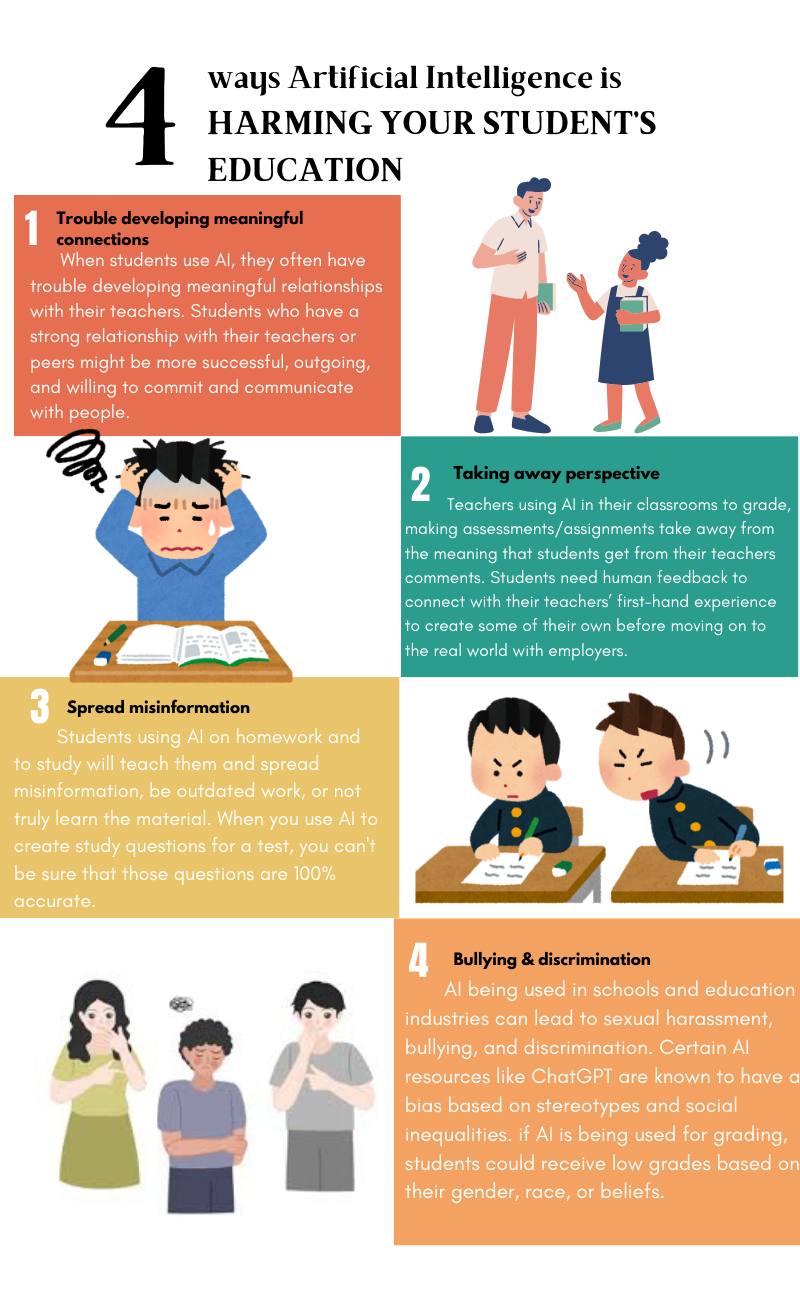
 Artificial intelligence is everywhere. It’s in video games, music, healthcare, social media, education and more. But what is the impact of AI on students’ education? The impact of AI on a student’s education are not limited to trouble developing relationships with teachers and peers, teachers using AI to grade or make assignments, students using AI on homework, sexual harassment, bullying, and discrimination.
When students use AI, they can often have trouble developing meaningful relationships with their teachers. These relationships are a part of the foundation of their education. When students have a strong relationship with their teachers or peers they’ll have a higher likelihood of being successful, more outgoing, and willing to commit and communicate with people. This not only benefits them as a person but in their high school career as well. According to Walden University, “ If students interact with a software program more than with a teacher, they can begin to feel disconnected and isolated. Their motivation and engagement may decrease, which could lead to an increase in dropout rate.” This shows that students need the interaction and the development that comes with it. Without it they’ll just add to the already persistent dropout rate in high schools.
Teachers using AI in their classrooms to grade, make assessments/ assignments will take away from the meaningfulness that students get from their teachers comments. Students need real human feedback to connect with their teachers first-hand experience to create some of their own before moving on to the real world. Most jobs won’t be using AI to back up their feedback to employers. So, why should teachers start doing that to build that cushion for students now? Feedback Fruit explains what students gain from feedback, “ It helps students understand the subject being studied and gives them clear guidance on how to improve their learning.It strengthens the classroom communication between teachers and students. Feedback can improve a student’s confidence, self-awareness and enthusiasm for learning, leading to enhanced retention. ” This is going to help students more than automated responses that don’t actually provide them with ways to improve their work and learning.
Students using AI on homework and to study will teach them and spread misinformation, be outdated work, or not truly learn the material. Using ai on every or most assignments will also promote cheating and plagiarism. When you use Ai even to create study questions for a test, you can’t be sure that those questions are 100% accurate. So students will waste time learning outdated and false information instead of learning the material that will help them succeed on tests of future careers. According to education week, “ Other big concerns also showed up in the results. Seventy percent of teachers worry that AI weakens critical thinking and research skills, according to the report. It draws from nationally representative surveys of public school teachers in grades 6-12, parents of students in grades 6-12, and students in grades 9-12, and was conducted between June and August.” This is especially dangerous for students that want to have a college career after high school because you can’t use Chat GPT on SATs, PSATs and other tests.
AI being used in schools and education industries can lead to sexual harassment, bullying, and discrimination. Certain AI resources like ChatGPT are known to have a bias based on stereotypes and some social inequalities. Then if a biased AI is used for grading, students could receive low grades based on their gender, race, or beliefs. According to Stanford University HAI, “Starting in 2023, researchers found that generative AI models were being misused to create sexually explicit images of children. AI-generated child sexual abuse material (CSAM) has become easier to create thanks to the proliferation of generative AI software programs that are commonly called “nudify,” “undress,” or “face-swapping” apps, which are purpose-built to let unskilled users make pornographic images. Some of those users are children themselves. These programs are bringing more danger to children using AI and the kids they are likely to expose it to.
In conclusion, the impact of AI on a student’s education commonly leads to trouble developing relationships with teachers and peers on a regular basis. Whether it’s conversations that are serious or are not. Then teachers are using AI to grade or make assignments. This takes away the perspective students get when they receive teacher feedback. When students use AI on homework they are missing the opportunity to learn the material needed for class. Finally students may be exposed to abusive material that could cause sexual harassment, bullying, and discrimination.