Imagine a world where computers can help doctors catch life threatening diseases like cancer faster and more accurately than ever before. This is what’s already happening today with Artificial Intelligence (AI). AI is assisting physicians by detecting cancers on x rays, organizing patients records, controlling medical records. Some worry about relying on technology in health authorities , however AI has a helpful and effective approach to improve patient’s health outcomes and make hospitals safer.
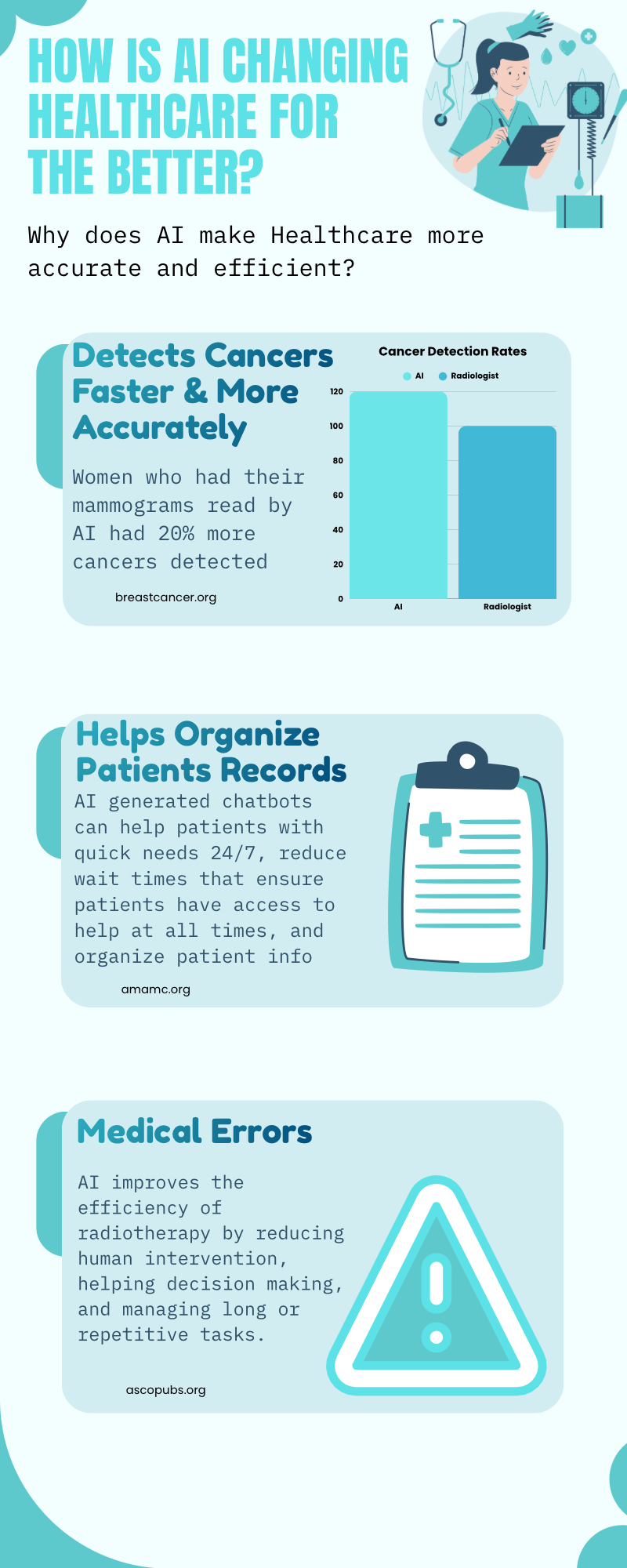
AI is transforming medicine by providing effective and more accurate cancer detection. One x-ray can save a life, but what if AI could read and detect it faster and more accurately than a doctor? AI is already doing this in hospitals around the world helping health professionals in cancer detection. Studies show that when AI is used as an assistant to doctors and radiologists, overall accuracy of early cancer identification is higher. The ability for AI to pick up on subtle and beginning signs of cancer that the human eye might miss lowers the chance of false negatives and positives. According to breastcancer.org, in Sweden, researchers used AI to help screen mammograms of 80,000 women. Half of the women had their mammograms read by AI before it was looked at by a radiologist, while the other half had theirs read by two radiologists. The AI group had 20% more cancers detected than the radiologists group. This further proves that AI makes cancer identification more accurate and specific. When cancer is more intricate and specific, patients can start treatment sooner. This helps prove that AI detects cancers on x-rays more precisely and exactly compared to just relying on the human eye alone.
AI keeps hospitals running smoothly and efficiently by organizing patient records quickly and providing easy access to their history. A lot of hospitals and other medical facilities already use AI systems that track patients’ medical history, test results, and pull up important information quickly. One of the best things about AI in healthcare is how it can improve patient communication. AI generated chatbots can help patients with quick needs 24/7 that reduce wait times that ensure patients have access to help at all times. At University of Pennsylvania’s Abramson Cancer Center an AI text messaging system called Penny is used. Patients receiving oral chemotherapy for gastrointestinal cancers are contacted daily by Penny to confirm their medication plan for the day and to ask about their physical and mental well-being and side effects. If a patient’s. When patients’ questions and records are organized correctly, doctors waste less time searching for files and more time caring for patients. With medical records coming from different sources, states, and times can become difficult for doctors to track or understand. Hospitals that use AI can get through the overload by identifying key points in patients data and sorting their information effortlessly. This shows that using AI improves the speed of patient care in hospitals.
With AI’s precise and quick pace analysis, medical mistakes are reduced and patients are safer and better protected. AI acts like a safety net in hospitals by catching mistakes before they affect patients that makes healthcare safer and more reliable. AI double checks patient’s information and drug prescriptions that assist nurses and doctors when they might overlook these small mistakes. According to JCO Global Oncology AI can overall improve the efficiency of the radiotherapy process by reducing human intervention, aiding decision making, and efficiently managing long or repetitive tasks. This safety net helps make healthcare safer and more reliable because medical areas are a major cause of harm in hospitals. 1 in 10 patients are harmed from unsafe care in hospitals globally. Using AI as an assistive tool can improve patients’ recovery and save lives.
AI is not being used to possibly replace doctors and nurses, but to support them. Improving the accuracy of diagnosis, reducing mistakes, and providing 24 hour chat bots are all ways AI is being used to improve the healthcare field. When AI is combined with a doctor’s skill set we can see advances in early diagnosis, better hospital care, and safer healthcare for everyone. Using AI in medicine isn’t about making doctors extinct, but it’s about saving lives and improving care for patients.